Between the Head and the Heart
The Son Must Answer the Call
“Der Sohn muss an die Fahne”
This is how Leopold Marx described the sharp turn his life had taken, in a poem he wrote to his brother Julius. In its very first lines, he reveals how he felt: “With great difficulty, I parted from the dream of my youth.”
In this chapter, we return to the beginning of Leopold’s journey and the events that shaped his youth- from the sudden death of his father, Eduard, which completely changed his future, to his first love- a love that was never fulfilled but left a deep mark on him for many years.
Leopold Marx was born on December 8, 1889, the eldest son of Eduard Marx and Babette Rothschild, who had married in 1885. He was followed by his brothers Julius and Alfred, and their younger sister, Grete. The four children grew up in a well established family in Cannstatt, where their father headed the family factory.
But their peaceful childhood ended much sooner than expected.
In February 1904, Eduard Marx died unexpectedly at the age of only fifty. His body was cremated and his ashes were placed in an urn, a choice that reflected a liberal religious outlook. (As is well known, in Orthodox Judaism it is customary to bury the deceased in the ground, based on the belief that a person returns to the earth and awaits the resurrection of the dead when the Messiah comes.)
Leopold was only 14 years old at the time, and his younger sister Grete was just two. Within a short time, he was forced to leave the Gymnasium and prepare himself for a role he had never chosen- to follow in his father’s footsteps and take responsibility for the family factory. His brother Julius was also forced to leave school, and neither of them had the opportunity to complete their final school examinations.
Only the third brother, Alfred, was able to continue his education, pursue academic studies, and eventually become a judge. Grete turned to the creative world and studied at the School of Applied Arts together with her cousin, Alice Bloch.
For Leopold, mourning his father became, almost overnight, a turning point in his own life. At an age when most boys his age were still sitting in classrooms, he had already begun carrying responsibility for the future of his family and the factory on his shoulders- a responsibility that would shape his entire life.
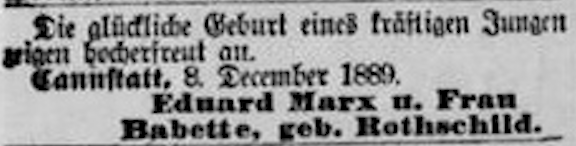
Translation from a local newspaper announcing Leopold’s birth:
With great joy, we announce the happy birth of a healthy and strong son.
Cannstatt, December 8, 1889. Eduard Marx and his wife Babette, née Rothschild
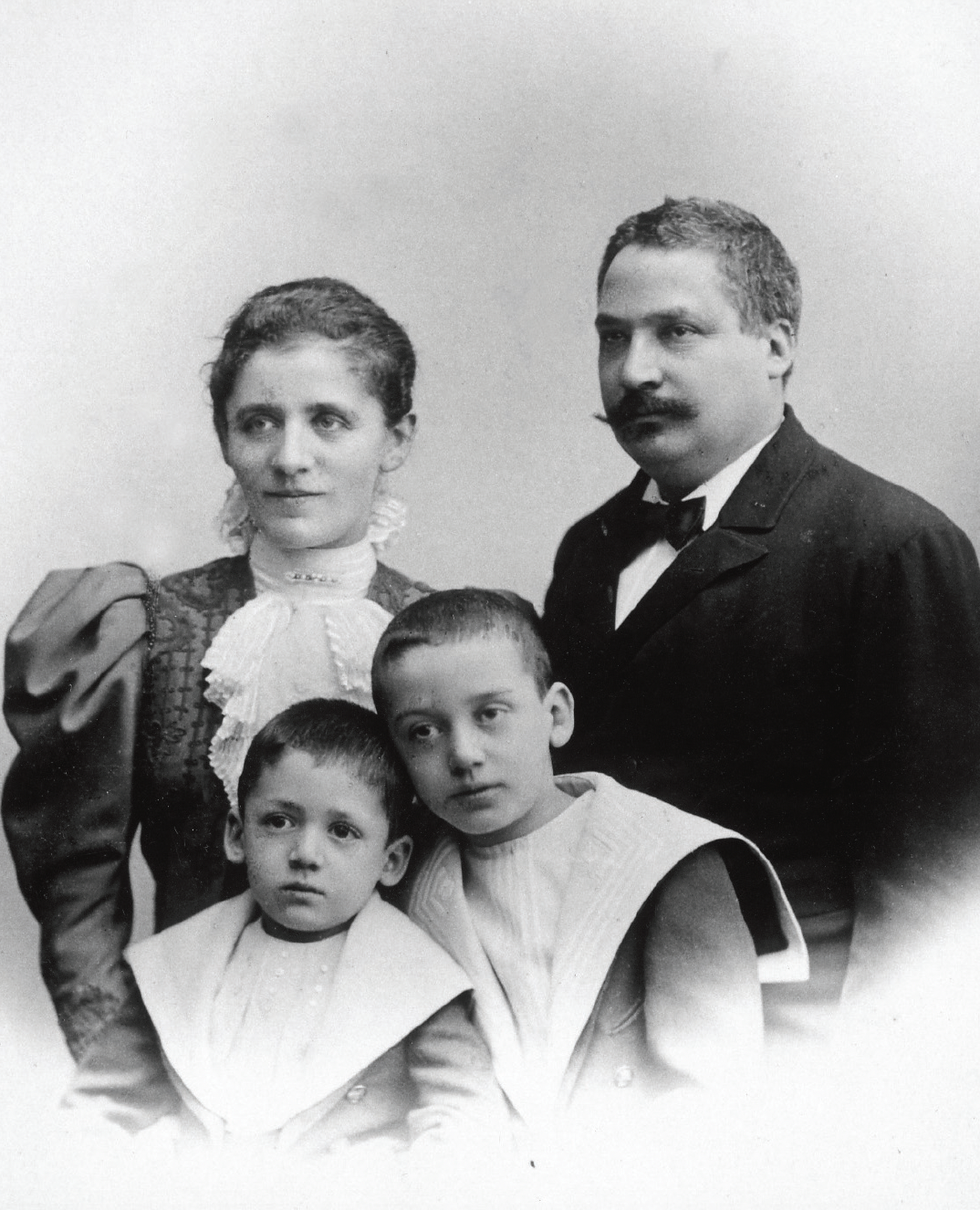
Leopold, Julius and their parents, 1898
After leaving the Gymnasium, Leopold was sent for a period of training at the textile school in Barmen. He later completed his professional and commercial training through periods of practical experience in London and Paris, a path that lasted four years in total.
When he returned from Paris in 1909, Leopold was only 19 years old, yet he was already at the head of the family business and carried full responsibility for its management. But he had not chosen this path out of passion. He had chosen it out of a profound sense of duty.
Throughout his life, this feeling of obligation remained with him. It ate away at him from within and created a constant struggle between the person he wanted to be and the person he was expected to be- in other words, between his natural inclination to become a writer and poet and his obligation to follow in his father’s footsteps as the owner of the family factory.
When I read his story, I thought about how familiar this pattern is, and how it repeats itself in almost every family. When a person learns from a young age that it is their duty to meet the expectations of their parents and those around them, they may begin, again and again, to place their sense of obligation to others above their own personal desires.
Over time, suppressing this inner voice can develop into a pattern of people-pleasing—a constant attempt to put the needs of others first, a deep fear of disappointing them, a tendency to carry enormous responsibility on one’s shoulders and to meet every expectation, even at the cost of giving up parts of oneself.
From the outside, such a person may appear functional, successful and responsible, while inside they may feel emptiness, frustration and sometimes even resentment. These feelings can eventually turn into anger whose source is difficult to understand, when in fact they arise from the distance that has developed between the person and their inner voice and true desires.
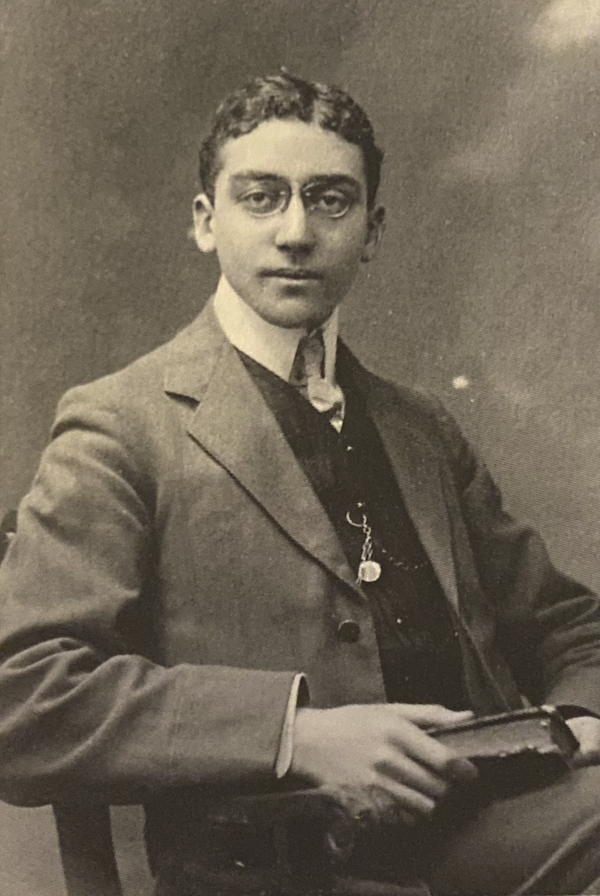
All the Responsibility in His Hands.
Leopold Marx, Paris, 1909
Leopold was, first and foremost, a man of the spirit. He was drawn to literature, poetry, and philosophy far more than to the world of commerce, in which he was forced to participate out of duty.
In his book, he wrote about it:
“Keep the businessmen away from me! I do not like them, even though I am forced to be one of them myself. It is a profession invented by the devil. At first, I too wanted to be a ‘good businessman,’ and I said something that was not true in order to buy at a better price. Afterwards, I was ashamed, and I learned from this that it is possible to conduct your business without lying, just as it is possible to conduct life in general. Only a few people in the business world do so.”
These words reveal the moral conflict that accompanied him throughout his life. Leopold set an exceptionally high moral standard for himself and for those around him, and at times he found it difficult to reconcile himself with the values and demands of the business world.
To find relief from the reality that weighed heavily upon him, he often became deeply absorbed in philosophical and spiritual ideas, looking at life from a dreamy perspective. But this, too, came at a price. As the saying goes:
“The highs are high, and the lows are low.”
His moments of elation were especially intense, but his moments of despair were equally deep. Over the years, the sharp fluctuations in his moods and inner world were balanced by his wife, Judith. She radiated calm and serenity, love and understanding, and again and again gave him back the balance he had lost.
But even before he met Judith, there was another source of pain in Leopold’s life that never truly let go of him.
First Love, Forbidden Love
When Leopold was around 18 years old, he met former school friends who had already begun their lives as university students. They spoke enthusiastically about their romantic adventures and student life, while he sat beside them with a sense of having missed out, after being forced to give up both his education and the youth he had imagined for himself.
At that age, it was almost taken for granted that every student would have a young woman by his side as part of student life. Leopold, who had been forced to grow up early and take responsibility for the family business, felt that these experiences belonged to a world very different from his own.
But shortly afterward, amid the festive crowds gathered in front of the royal palace in Stuttgart, he met a young woman who would change his world.
1911
The Kingdom of Württemberg was still an independent kingdom, and its people were very fond of their king, Wilhelm II. When the king and his wife celebrated their silver wedding anniversary, the city of Stuttgart filled with festivities. That evening, a spectacular fireworks display was held in front of the palace, and thousands of residents took to the streets to watch.
Leopold arrived with a friend from outside the city. Amid the crowds, noise and excitement of the celebrations, they made their way into the gathering and waited for the fireworks to begin.
As darkness fell and the show was about to start, they found themselves standing in the heart of the crowd. The voice of a young woman standing directly behind him caught Leopold’s attention. She was talking with her friend about ordinary, insignificant things, but there was something about the way she spoke- in the tone of her voice, her choice of words, and her gentleness- that made him turn around.
Even before he saw her, it was her voice that touched him. When he looked back, he felt that his eyes merely confirmed what his ears had already known.
Standing before him was a young woman with delicate features, dark-blond hair and kind, dreamy eyes. She was dressed simply and modestly, and there was a quiet gentleness about her that captured his heart from the very first moment.
Her name was Elsa, as he heard her friend call her. But in his heart, he had already given her another name-Elisabeth. To him, that name seemed far more fitting for the delicate young woman standing before him.
Leopold was shy by nature. It would never normally have occurred to him that one could simply approach a young woman in the street. In general, he found it difficult to break through the barrier of unfamiliarity between one person and another on his own initiative. Dance halls and other places of entertainment did not particularly appeal to him either, and even on the rare occasions when he visited them, he always felt that this was a world to which he did not truly belong.
But something was different that evening. Perhaps it was the festive atmosphere that swept him along and made him feel part of the crowd, or perhaps it was Elisabeth’s childlike openness and gentleness. Either way, she awakened in him a courage he was not used to feeling.
And it was Leopold- not his friend, who was usually more relaxed and experienced- who began a brief conversation. To the other two young people, it was merely a chance encounter on a single evening. But for Leopold and Elisabeth, that small conversation would become a moment that changed their lives.
Elisabeth’s excitement continued throughout the fireworks display. Her innocent, childlike joy stood out beside her friend’s more indifferent reaction. The colorful lights over Stuttgart followed the four young people as they continued the evening together.
After the fireworks ended, the crowds filled the city streets. The two couples walked along with them until they found a quiet corner in a busy café, where they could rest and keep talking. Later, they took a carriage together to another place in the city.
Elisabeth was modest and shy. It was clear that she was happy that a tall, slim and well-dressed young man had chosen to spend the evening with her. But she did not have the confidence or sophistication of the young women Leopold had known before. She was natural, simple and genuine.
At one point during the carriage ride, Leopold hesitantly tried to put his arm around her shoulders. Elisabeth gently moved it away. Instead of creating distance between them, the small gesture only increased the feeling of respect, warmth and innocence between them.
On the way, they passed the grand ballrooms of the palace. Through the windows, they could see princesses and elegant women in beautiful dresses and feathered hats. The hats especially caught Elisabeth’s attention. She knew them well, as many were similar to the ones she worked on as a milliner.
For a moment, she allowed herself to dream. She imagined a life without poverty or worries about money, without the suffocating air of the millinery workshop and without the constant worry about her sick mother.
The young man beside her, dressed elegantly and behaving like a gentleman, seemed almost like a prince. For a moment, it felt as if he had come from that distant world and opened a small window into another kind of life- a life she had only dreamed about until then.
After that first meeting in front of the royal palace, Leopold and Elisabeth became closer. Every meeting brought them nearer to each other, and everything new they discovered about one another made their world feel richer and more beautiful.
They felt that nothing could separate them. Differences in social class, family expectations and social rules seemed less important compared with their love for each other.
Behind Elisabeth’s smile was a difficult life. Her small income was not enough to support both herself and her sick mother, so she also worked as a milliner in the evenings and on Sundays. Leopold saw how difficult her situation was and wanted to help, but he was careful not to hurt her pride.
Elisabeth had been born to an unmarried mother, something that carried a strong social stigma at the time. But Leopold saw honesty and goodness in her. He did not want to take advantage of her situation. He wanted to love her, protect her and perhaps one day marry her.
The more he got to know her, the more he discovered her love of books, her curiosity and her wish to learn and grow. He encouraged her to read and helped her discover new ideas, and she gladly accepted his advice and support.
Without realizing it, their relationship had already become deep and serious. The future seemed full of hope… but just then, the first problems began to appear and threaten their love.
Elisabeth’s insecurity continued to grow, and she found it increasingly difficult to believe that she was truly worthy of Leopold’s love, devotion and generosity. At the same time, rumors about the relationship between the son of a wealthy Jewish family and a young woman from a “simple background” began to reach his family as well.
How would Leopold respond to the pressure from his family? Would he once again choose what was expected of him, or would he finally listen to the desires of his heart?
When we are unaware of a deeply rooted pattern within us and are unable to free ourselves from it, it tends to appear again and again in our lives in different forms. Reality continues to place the same lesson before us- until something within us changes.
More about this, and about the continuation of Leopold and Elisabeth’s love story, in the next chapter.
