In the name of Love
In the previous blog, we met Elisabeth, Leopold Marx’s great (and forbidden) love, and followed his inner struggle between his heart and his head- between his own wishes and dreams and his responsibilities to his family.
As the relationship between the two young lovers deepened, it became clear that the obstacles and doubts were not coming only from the outside. Elisabeth herself struggled to believe that she was truly worthy of his love. Being born outside of marriage and growing up without a father had left her with a deep sense of inferiority, while Leopold carried a different kind of feeling of not belonging - as a Jew growing up in Germany.
In this chapter, we will get to know them both much more closely - Elisabeth’s insecurities, the stories of their two families, and Leopold’s attempts to help her build a different future.
And through it all, the same question that follows their story comes up again: Can their love bridge not only what society thinks of them - but also what they think of themselves?
“What do you even see in me?” Elisabeth asked. “So many times… when I ask myself that question, I can hardly understand it.”
“The girls from your social circle have an advantage over me in every way. They have beautiful clothes, they take care of themselves, they study English and French, they draw, play music, and play tennis.
“And me? All I know how to do is decorate hats in a rather silly way, sew, and do a little housework, like any poor girl. And on top of that, in almost every letter I make spelling mistakes that you have to point out to me.”
Leopold tried to change the way she saw herself. He was not as impressed by the education and manners of high society as she was, and sometimes even saw a great deal of falseness in it.
Elisabeth herself did not agree with his generalization.
“And what about the daughters of respectable families? Surely they are not all false. There are all kinds among them, just as there are among us. But look at your little sister! Everything you have told me about her challenges your whole argument, and her photograph even more so.”
Leopold replied:
“The fact that you like my sister, Greta, is only natural, even though until now you have known her only through my stories. First of all, she really is special. Almost everyone genuinely loves her, because there is something bright and full of soul in her character. And secondly, it is only natural that you share this love with me.”
But the difference that troubled Elisabeth most was not social status, money, or education. It was the fact that she had been born outside of marriage and had grown up without a father. She felt that this would always place her one step below others. Her father’s family was completely unknown to her. He lived in another country with a wife and children, and she had never met him, his family, or even learned the language spoken there.
Leopold thought about how he could improve Elisabeth’s life and ease some of her pain. He hoped that if some kind of connection could be created with her father, perhaps the feeling of rejection that had followed her throughout her life might finally disappear. He therefore tried to convince her to contact him. In Leopold’s eyes, if her father could only get to know his daughter and see what a loving, intelligent, and accomplished young woman she had become, it was difficult to imagine that he would not feel proud of her.
Elisabeth strongly opposed the idea. As far as she was concerned, that relationship had been lost long ago. Her father had never cared for her or her mother, and even before Elisabeth was born, he had insisted that her mother leave and return to her hometown. Leopold still believed it was worth trying: if the attempt succeeded, there would be much to gain, and if it failed, the worst that could happen was that her father simply would not reply.
In the end, without Elisabeth’s knowledge, he wrote to her father, hoping that he would at least acknowledge his daughter. He put a great deal of effort into finding the right tone for the letter, but in the end, she was right - her father never replied.
Later, Leopold heard about a young girl who carried the father’s surname and lived in the same area. He wondered whether she might be Elisabeth’s half-sister, but that lead also came to nothing. About six months later, while traveling, he passed through the mountain village where her father lived and even considered going to meet him. In the end, he decided against it and chose not to enter his life without an invitation.
Leopold may not have succeeded in easing Elisabeth’s pain in this way, but he found other, far more generous and practical ways to help her and her mother and improve their lives.
The conversation about Elisabeth’s father revealed other points of connection between them.
Leopold had also grown up without a father, but their experiences were very different. Elisabeth’s father was alive yet completely absent from her life, while Leopold had known his father and had the chance to grow up with him.
Leopold described his father as a man of action, someone to whom the family owed much of its success. He had good friends, and even his workers were fond of him. Their relationship had not always been easy during Leopold’s childhood, but just as he reached the age when they could truly grow closer as father and son, his father died.
Despite the differences in their stories, they both had to find their way through life without a father by their side.
Another point of connection between them was their shared sense of being outsiders. Leopold tried to explain to her that, in a way, he too had been born with a “stigma” placed on him by society. If society judged Elisabeth because of her mother and the fact that she was born outside of marriage, it judged him for being Jewish.
But Elisabeth saw an important difference between them:
“Yes, the Jews are a people who have suffered greatly and have been scattered throughout the world. But you have family, a community, a shared past, and a sense of belonging.
“And I… I have almost nothing but my mother.”
Elisabeth’s life left her almost no free time. Even as a young woman, she helped her mother, who suffered from health problems, and carried much of the responsibility at home. Leopold understood that she needed rest and sent her on a holiday in the Black Forest.
For Elisabeth, it was a completely new experience: for the first time, she had days without work or worries, surrounded by nature and books. In the letters she sent Leopold, he also discovered that she had a natural talent for writing and storytelling.
Elisabeth also told him about her mother, a woman who had worked hard all her life but always shared what little she had with others.
“When one of our neighbors drowned and his young wife developed tuberculosis after giving birth, my mother cared for her until she was admitted to the hospital. She took the baby girl into our home and raised her as if she were her own. She asked some of her clients for baby clothes and got milk from farmers she knew. The little girl, named Annele, stayed with us for an entire year. After her mother died, she was sent to an orphanage.”
When Leopold heard the story, he immediately began thinking about how he could help Elisabeth’s kind-hearted mother. She suffered from joint pain and lived on the fourth floor, and the thought that came to him was obvious:
She needed help moving to a better apartment.
A change of place, a change of luck
The new apartment was small — only two rooms — but it was in a much more pleasant location, with an open view. Across from them was a large garden filled with flowers and fruit trees, surrounded by fields and hills.
But the most important change was in Elisabeth’s mother’s health. In the new home, she came back to life and felt healthier than she had in a long time. Her improvement opened up a possibility for Leopold that he had not considered before.
For a long time, Elisabeth refused to accept money or help from Leopold, and her mother had warned her against it as well. At first, she was suspicious of his intentions and told her daughter that no one did such things without expecting something in return. Only with time, as her trust in him grew, did those fears begin to disappear.
While Leopold’s bond with Elisabeth and her mother was becoming stronger, things looked very different in his own world. His attempts to create a social circle for Elisabeth outside the family almost always failed — none of his friends understood a relationship like theirs.
They had to keep most of their meetings secret. If they went to public events, he always had to consider the possibility of running into someone he knew. It had already happened before: while out together, they met some of his cousins and aunts, and the talk and gossip began immediately. It was uncomfortable and embarrassing for him, and even more so for her.
On the back of one of the first letters he sent Elisabeth, a few lines written by Leopold in pencil were found:
“Now come at me, you safe and respectable ones,
you honorable and righteous people, you pillars of virtue.
You can tear the trousers from my body,
you can cast me out of your circles,
you can roast me while my bones are still alive,
and you can even do it with calm and reasonable judgment.
But you will not break me.
…You will never get my girl out of my head.
And if you still have any doubt — then may the devil take you!”
A Better Future
Leopold thought about how he could help her build a future in which she could stand on her own — and perhaps also make it easier for his family to accept her.
One thing was clear to him: her work in the sewing workshop had to come to an end. Elisabeth wanted that very much too. Training as a nurse specializing in the care of babies seemed best suited to her wish for a meaningful life. Elisabeth hoped that having a respected profession might change the way society saw her.
But the transition from the world of feathered hats to the world of nurses’ caps was not simple. Elisabeth had only completed elementary school, and even becoming a nurse outside a religious order required a level of education she did not yet have. Before anything else, she would have to continue her studies.
Here too, money was needed. After much thought, they decided that the next step would be for Elisabeth to study in France. Leopold knew France from his travels and loved both the language and the country, which was also regarded as a place of culture and education.
As the journey approached, Elisabeth began studying enthusiastically at a language school, took additional lessons, and devoted the rest of her free time to books. Little by little, the young woman who only a short time earlier had lived in an old apartment in a less desirable neighborhood and knew little beyond sewing and housework was beginning to prepare for an entirely different life.
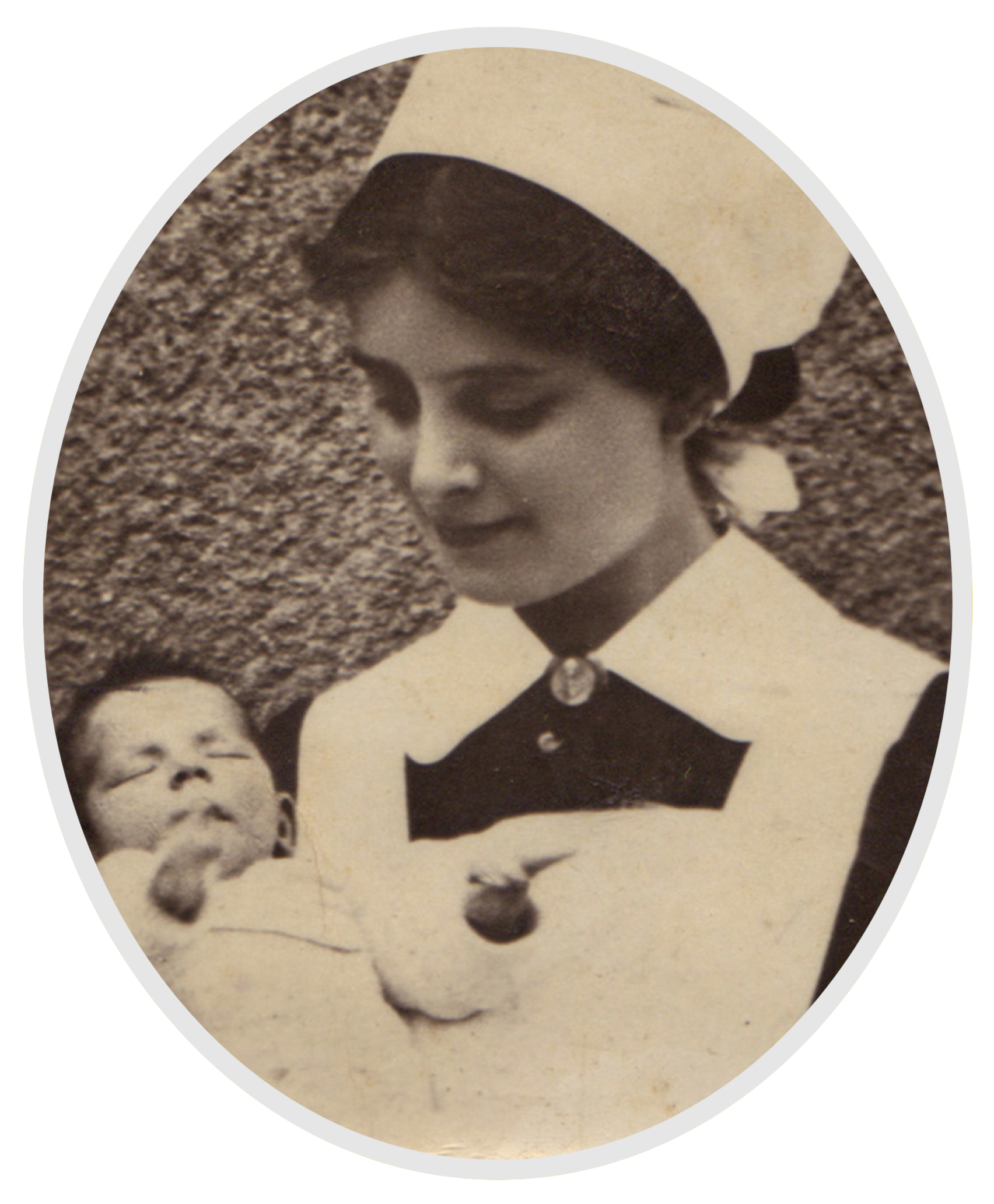
Nurse Elisabeth
A New Year, a New Beginning
Few things make a sense of not belonging more noticeable than the holiday season. Among Jews who grew up in a German environment, there was hardly a child who did not feel a small sting of being different when looking at the brightly lit Christmas tree in a neighbor’s home.
Leopold had known that feeling since childhood. In his parents’ home, a Christmas tree was put up for the household staff, and the children received a few gifts along with them. But as he grew older, his relationship with Judaism and with his own sense of belonging became more complicated.
During one of their conversations, Elisabeth said:
“You know, if I were your wife and we had children—”
“Wow, you’re looking far ahead! I know a good eye doctor.”
The young woman looked at him and fell silent.
“Perhaps this was not a good time for jokes,” Leopold said. “Forgive me. It is strange. For my part, I am not willing simply to deny that I belong to this people. And you are absolutely right: if we had children, we would have to begin again for their sake.”
As Elisabeth tried, out of love, to understand Leopold’s complicated world and his relationship with Judaism, she also wanted to make him happy on his birthday and bought him a picture as a gift — an engraving by an important Jewish artist. But when Leopold received it, he was not in a good mood. The pressure of his work and the demands of everyday life had taken over, and instead of seeing the thought and meaning behind the gift, his first reaction was:
“Why does she need to spend so much money on such an expensive gift when she and her mother need it so badly?”
Leopold had never been good at hiding his feelings, and Elisabeth immediately noticed his reaction. She was deeply disappointed and hurt, because she had expected the gift to make him happy.
Leopold felt he had to do something to repair the hurt. Elisabeth and her mother were the kind of people who simply had to bring joy to others and give them gifts, even when they had very little themselves. Both of them had a special affection for children, and Leopold loved this quality in them.
So, to seal their reconciliation, he gave her everything she needed to hold a Christmas celebration for children for the first time in her life.
Delighted, Elisabeth and her mother chose clothes, toys, and sweets together, and prepared a particularly beautiful tree with candles and decorations. The neighborhood children were invited, and Elisabeth’s mother was so excited and happy that, for a moment, she even forgot her pain.
And so their first Christmas together arrived - and, as it turned out, also their last.
Leopold spent the evening with Elisabeth, her mother, and the neighborhood children. The joy of Christmas was mixed with the sadness of Elisabeth’s approaching departure. On New Year’s Eve, they said goodbye.
“From the edge of the hill, we looked down at the long rows of city lights and waited together for the moment when the new year would begin. When the bells rang, when the lights of the Christmas trees shone in the houses and cheerful voices could be heard, we stood in a dark street corner at the edge of the city, like two refugees with no place beside a warm hearth. And in our kisses we felt our rootlessness, our estrangement from every place and every framework.”
Shortly afterward, Elisabeth set out on her journey. Leopold accompanied her to the railway station, after making sure she had everything she needed for the beginning and preparing her as well as he could for what awaited her in France.
Elisabeth began her journey full of hope, love, and trust. The great and unfamiliar world was waiting for her, and for the first time she felt that she was truly setting out toward a new life.
How far are we willing to go in the name of Love?
Leopold, a man of words, undoubtedly proved his love through actions as well. He did everything he could to bring happiness to Elisabeth, whom he loved so deeply. He tried to strengthen her confidence in herself, sent her on a holiday, helped her move to a better apartment, supported her on the path toward a new profession, and sent her to study in a foreign country.
All of this was done with the hope of a shared future, and with the desire to give Elisabeth the chance for a different life- one that was better and more secure - and perhaps also to make it easier for his family to accept her.
It is important to remember that the young Leopold did all of this while already managing the factory, taking responsibility for its workers, and carrying a large share of the responsibility for the family’s income. At the same time, he also took it upon himself to help care for Elisabeth’s sick mother.
Money, love, and support can change many of the circumstances of a person’s life - they can open doors, create opportunities, and provide comfort. But can they heal years of rejection, shame, and feelings of inferiority, and change the way a person sees themselves?
Perhaps love cannot always erase the wounds a person carries, but it can offer, even for a moment, a different way of seeing oneself. It can show us what another person sees in us, and sometimes give us the courage and confidence to begin a new life.
And now comes the real test: How will Elisabeth manage in France? How will their relationship survive the distance? Will their love also be able to bridge the religious differences between them? In the next chapter, we will continue their love story - up to the time when Leopold is called into military service.
chapter, we will continue their love story- up to the time when Leopold is called into military service.
