When we left Leopold, he had already spent nearly two years as a prisoner of war in France. He had survived hard labor, hunger, punishment and solitary confinement - but also experienced unexpected moments of kindness that helped him endure.
Far from home, Judith and Elisabeth were still waiting for him, connected by their love and concern for the same man. But as the war moved closer to its end, their complicated relationship was about to change once again.
In his darkest moments, Leopold found faith- and with it, a new way of looking at himself, his life and the future he hoped to return to.
But before Leopold could find his way home, one final fight for his freedom still remained.
Meanwhile, Back Home
As the immediate danger to Leopold’s life began to fade and Judith could once again imagine a future with him, hope was joined by fear. She noticed that in his letters to her, he never mentioned Elisabeth at all — and that silence began to trouble her.
Judith started to fear that Leopold’s feelings for Elisabeth had never completely disappeared and might now be returning. She grew colder and more distant from both of them. Elisabeth noticed the change too, but Judith explained it as the result of her heavy workload. Eventually, however, she admitted what was really troubling her: she feared that Leopold’s love for Elisabeth had never truly died, but had only been pushed aside.
Judith Is Tired of Sharing Leopold
After a long inner struggle, Judith reached a painful decision. Despite her love for both of them, she decided to write almost the same letter to each. She wrote that true attraction and love could not simply be suppressed, and that if things continued this way, all three of them might end up trapped in an impossible situation — with a ruined marriage.
At the same time, she made it clear to Leopold that she was not asking him to cut Elisabeth out of his life. The caring friendship through which he had supported Elisabeth for so long could continue. She ended her letter to Elisabeth with the words:
“By everything that is sacred to you, my Elisabeth, I ask you: know yourself and think carefully about your future. Take care.”
The letter reached Leopold only weeks later. He read it - but did not reply.
As a prisoner, he was allowed to send only two letters and two postcards each month, and for weeks Judith did not receive even a single personal letter from him. She was deeply hurt and began to wonder whether his silence was connected to what she had written about Elisabeth — and whether Leopold was angry with her.
She wrote to him in pain:
“I want to be careful not to be petty, selfish or unfair, but this distance simply hurts… Am I not the person closest to you?”
Only months later was Leopold finally able to answer. He described his situation: where he was, there were no songs of gratitude, only “homesickness, longing from every direction.” He wrote about a stormy night when he felt as though his soul were rising out of the cold and pain because it could not fly away from that place.
Beyond the restrictions of censorship and prison correspondence, it seems that emotionally he also did not know how to respond. He did not argue with Judith, but accepted her decision to distance herself from Elisabeth — even though it was the opposite of what he had hoped for.
Only later did it become clear that there was another reason for his silence: during that period, Leopold was going through difficult experiences in captivity that Judith knew nothing about.
Escaping Reality
We are still in 1918. The train had arrived in southern France, and the camp Leopold was sent to was much better than anything he had known before. Leopold was put in charge of the camp library, and within captivity he found another way to escape reality — through reading and writing.
He read as much as he could, studied, and immersed himself in philosophical ideas. After the fateful encounter on the train, he also felt a growing desire to understand his Jewish roots more deeply. He discovered the writings of the Jewish philosopher Martin Buber, which were a true revelation for him. The experience was so powerful that his interest in Judaism stayed with him for the rest of his life.
His fellow prisoners sometimes laughed at his deep thoughts and called them “philosophizing,” but for Leopold they were a way to preserve an inner world in a place where almost all external freedom had been taken from him.
Hermann Hesse, the well-known German-born writer and poet, had been living in Switzerland since 1912. During World War I, he headed a relief service for prisoners of war and created a series called “Library for German Prisoners of War.” Its purpose was to bring literature and short texts to prisoners, many of whom had not read much before the war but now found themselves with plenty of time and a deep need to escape from reality.
Through this work, Leopold came into contact with Hermann Hesse. He wrote to him and included a few lines of his own poetry, explaining that he wanted to show him “what kind of grass grows in prisoner-of-war camps.”
“K. G. 3515”
Hesse was impressed and sent one of Leopold’s poems to the Frankfurter Zeitung newspaper. Leopold, who was too modest even to call himself a poet, insisted that his name not be published. With Hesse’s encouragement, he began to understand that what he was doing was more than simply “writing poetry.” The poem was published under his prisoner-of-war number, 3515 — and for the first time, Leopold’s writing reached a wider audience.
After the poem appeared, the newspaper began receiving requests from readers who wanted to know the author’s name and address. Hesse contacted Judith to obtain an address so the messages could be forwarded.
Leopold’s fellow prisoners also chose him as their representative to the Red Cross. In this role, he tried to help other prisoners and, among other things, accompanied the camp commander to distribute packages to sick prisoners in hospitals. Because he was suffering from a cold, he also received permission to go twice a day for inhalation treatments.
During his visits to the town on the Isère River, he sometimes received a good meal at the hospital, and on one occasion he and his companions even stopped on the way back to drink a bottle of wine. After years of captivity, even such a small moment felt incredibly special to him.
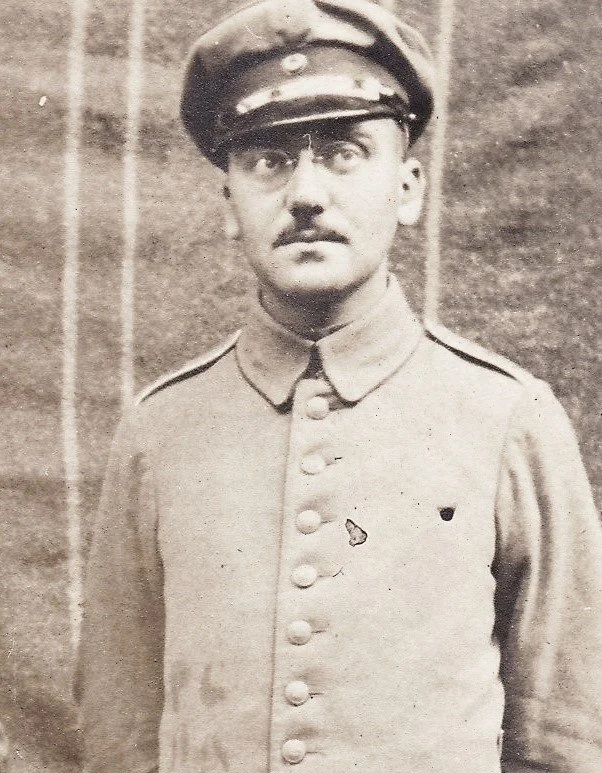
These trips gave Leopold more freedom of movement than usual, and he used the opportunity to begin preparing for an escape. He obtained civilian clothes, dyed them black, and started planning a way out.
The War Outside and the War Within
In November 1918, the German army’s final attempts to change the course of the war failed. The soldiers were exhausted, and the front lines were beginning to collapse. On November 9, Kaiser Wilhelm II gave up the throne and the German Empire fell. Two days later, on November 11, the armistice was signed. After more than four years of war, the guns finally fell silent.
Germany was left defeated and disillusioned. The monarchy was gone, the country became a republic, and the streets were filled with uncertainty, unrest and fear of revolution.
Prisoners in the defeated countries gradually began to be released and return home, while others were already imagining their own return. Julius and Alfred made it home safely. Leopold was alive, and Judith knew that sooner or later he would return to her. Elisabeth was waiting for him too.
But not everyone would see their loved ones again. Alongside the hundreds of thousands of soldiers who never returned home, the Spanish flu was spreading on both sides of the border. Unlike many epidemics that affect babies, the elderly and the chronically ill most severely, this one hit young people particularly hard. The war did not directly cause the outbreak, but the conditions it created seem to have helped it spread more quickly.
Meanwhile, Leopold was still a prisoner far from home. He used the time to fill gaps in his education and wrote down his thoughts in notebooks. For the first time in years, he had time to himself. He often climbed onto the wall of the small fortress where he was being held and looked out over the Alps and the mountain villages.
His inner world felt much the same - constantly moving between light and darkness.
And what about the other epidemic - the epidemic of the mind?
Leopold reflected on what he called a “sickness of the soul,” and on how such a sickness could be recognized and named. In his view, fear and hope were both part of being human. But two other forces - anxiety and greed - lay behind conflict and bloodshed.
Greed: the need to gain and possess. Anxiety: the fear of losing.
Anxiety arms itself, forms alliances, closes borders, bribes, slanders, lies, humiliates, arrests, imprisons, tortures and drives people toward war. Greed deceives, steals, oppresses, destroys and ruins whatever it cannot possess. So it was, so it would be — yesterday, today and always.
These forces had also shaped Elisabeth’s life, as they do the lives of all people. Her mother’s fear of society’s judgment over the very existence of her daughter — the result of her “second mistake” — had been passed on to Elisabeth almost from birth.
That pattern appeared again and again throughout her life. When she met Leopold, it seemed for a moment that love might drive away the darkness. But her fear of losing him remained and led to the first small lie, from which more lies followed. Anxiety weakened her confidence and, for years, became a source of inner suffering and avoidance.
But the war and her work changed her. The change could be seen in her letters. In one of them, she described her work at the maternity home: almost every day a new baby was born, and soon the number of babies born there would reach 900, most of them to soldiers’ wives. She described the waiting before a birth as a meeting between the present and the future — while one new life was beginning, she found herself thinking about entire generations disappearing from the world.
Her work took on a deep, almost spiritual meaning. In the end, she managed to overcome much of the anxiety that had followed her for years, and her life was presented as proof that “the great epidemic of the soul can be healed.”
November Winds
On one gray November day, Leopold received a letter in Judith’s handwriting — and with it came the terrible news.
My dear, our Elisabeth is no longer with us. She has passed through the dark gate from which no mortal returns.
The terrible illness that has already claimed so many victims took hold of her too. It lasted only a few days. On Monday evening, the hospital called and said that Elisabeth wanted to speak with me.
Your mother tried to persuade me not to go. With a heavy heart, I went there, even though the visit was allowed only at my own risk. But I went anyway, to our dear Elisabeth, with the strong feeling that I also had to be there for you.
And how grateful I am now that I was with her, that I was able to free her dear soul from the last of its worries. I found her thin and struggling badly to breathe. There was an indescribable fear on her face, and in those eyes that usually knew how to shine so brightly, I saw a pain that broke my heart.
Alongside her fear of death was her worry for her mother, and old feelings of guilt had also returned.
I spoke to her as much as I could and promised her that her mother would always be cared for. When I spoke to her about the soul continuing to exist after a person dies, she gradually became calmer and quieter.
We did not speak anymore. I only stroked her hands and her forehead, burning with fever, and with a faint smile on her lips she looked at me so deeply, as if she wanted to remember me and carry that memory with her into the next world.
I sat beside her bed like that for more than an hour. Then she whispered:
“Now I want to sleep, my dear. Now I feel at peace. Thank you.”
She fell asleep. And her heart stopped.
Later in the letter, Judith wrote that she was grateful she had not managed to distance herself from Elisabeth as she had once planned. Elisabeth had become too close to her heart, and being able to stay beside her during her final hours felt like a gift. She also wrote that Elisabeth’s final gratitude really belonged to Leopold:
He was the one who had filled her life - with pain, yes, but also with great love, meaning and enormous joy.
By the time the news reached him, Elisabeth had already been buried.
Leopold received the letter one evening in the camp, while around him the other prisoners were talking, laughing and singing. He was devastated, but could not bring himself to cry in front of them. When one of the men jokingly asked whether he was “philosophizing” again, Leopold answered only:
“Leave me alone. Someone dear to me has died.”
For weeks, he withdrew into himself. Slowly, his grief began to turn into words, poems and a deeply personal reckoning with himself. In the middle of that pain, his love and gratitude toward Judith also grew stronger — she had reached Elisabeth at exactly the right moment and stayed beside her through her final hours.
The Escape Home
The end of the war did not bring Leopold’s immediate release. France continued to hold German prisoners even after the armistice, and many of them were sent to clearing and reconstruction work in the former war zones. Leopold remained in France, among the prisoners who had to wait a long time to return home.
In the end, he decided to shorten his captivity himself - by escaping. On the very day he set out, exactly one year had passed since Elisabeth’s death. He took it as a sign. It seemed to him as though he could feel her breath beside him, as though the sound of her voice was pushing him forward and guiding his steps.
Only God knows where he found the last of his strength. From a camp near Saint-Quentin in northern France, he finally put into action an escape he had been planning for a long time. The night before he left, he prayed for hours and read Psalms in Latin. Then he set out.
Meanwhile, a local wine tavern had quietly become a kind of secret support point for prisoners who knew about it. The owners felt sympathy for them: they offered money, arranged false passports made by a French specialist, and gave them the names of trusted people in Paris who could help. After a warm meal, the escapee was taken to the train station.
In one of the train compartments sat a uniformed officer and three Spaniards. Leopold’s companions began enthusiastically asking them about border inspections, and Leopold worried that they were attracting far too much attention. As he later wrote, “I had every reason to fear that the man in uniform would become suspicious.”
Luckily, his fear did not come true. When the officer got off in Toulouse without looking back, Leopold got off too — just to be safe.
His next stop was Narbonne. There he had to spend several hours in rainy weather, but avoided waiting inside the station. Instead, he rode around the city in a carriage “like a wandering Englishman,” visited the cathedral and bought himself a loaf of bread.
From there he continued under his false French identity, taking a passenger train through Perpignan and Cerbère toward the border. In the crowded compartment, he quickly became involved in conversation, but his fluent French gave nothing away — and his false passport passed inspection as well.
Finally, the train entered a tunnel beneath the Pyrenees. When it came out the other side, Leopold was already in Portbou, Spain.
For the first time, he was truly free.
From there, Leopold sent a telegram to Switzerland. It was immediately forwarded and reached his family in Cannstatt on December 1, 1919 - his mother’s birthday.
About a month after beginning his escape, Leopold finally made it home. After only three weeks of married life together and more than three years apart, Judith was waiting for him at Christmas in Konstanz, on the German-Swiss border. There, Leopold could finally hold his young wife in his arms again.
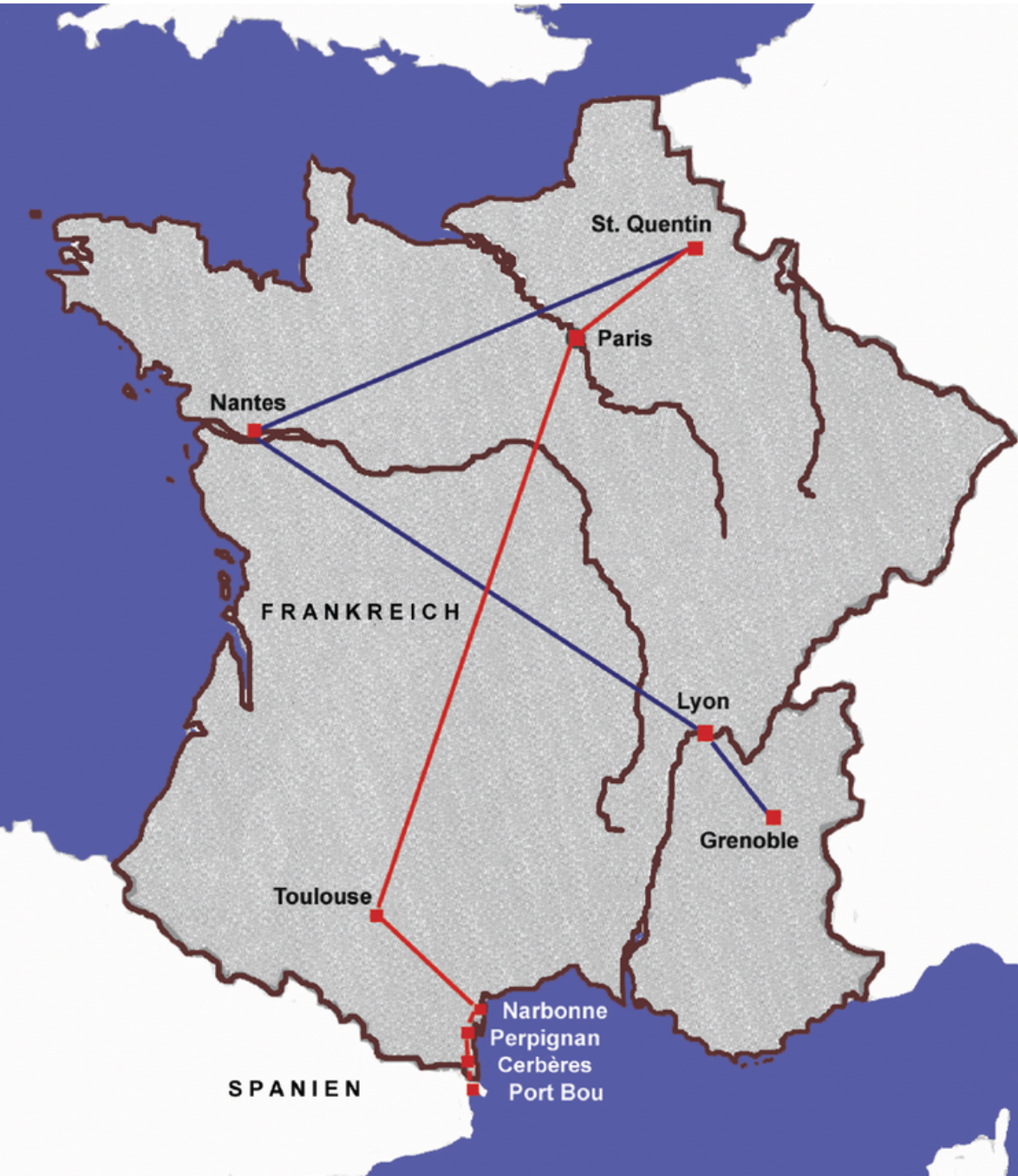
Leopold’s route between the prisoner-of-war camps in France (blue line) led from the south of the country to the northeast. In 1919, during his escape (red line), he made his way back south until he crossed the border into Spain and reached freedom.
Even after returning from captivity, Elisabeth never truly disappeared from Leopold’s life. One of the first places he went was Elisabeth’s grave. Because the original grave was temporary and intended to be reused after a number of years, he bought her a permanent burial plot, had her coffin moved there, and commissioned an artist to create her headstone.
Leopold continued to carry feelings of guilt connected to Elisabeth, along with a harsh inner reckoning that returned again and again at different stages of his life. Because death had taken away his chance to directly repair what he felt he had done to her, he looked for other ways to make amends through the way he lived.
As he had promised, he arranged a place for Elisabeth’s mother in a pleasant nursing home not far from her daughter’s resting place. Her daily walks to the grave and caring for the flowers there became a central part of her life. Leopold and Judith visited her regularly. She lived to an old age and died peacefully. At her funeral, Leopold met Elisabeth’s half-sister for the first time- the woman Elisabeth had once been so afraid to reveal to him- and the encounter brought old memories back to the surface.
In the years that followed, Germany declined step by step, and each stage brought new pain. The homeland Leopold had once fought for eventually pushed him into exile.
Gradually came the laws of separation, the loss of rights, the yellow star, the camps and the gas chambers. Leopold himself was arrested again, this time by the Gestapo. And if he had thought the worst was already behind him, nearly three more decades still lay ahead - years marked by mistrust, humiliation and suffering.
And yet, in his eyes, even that was not the end of the story. Looking back, he saw it as another step along the way: from so much death and destruction, something unexpected had grown. A people who had lost almost everything had found their way home.
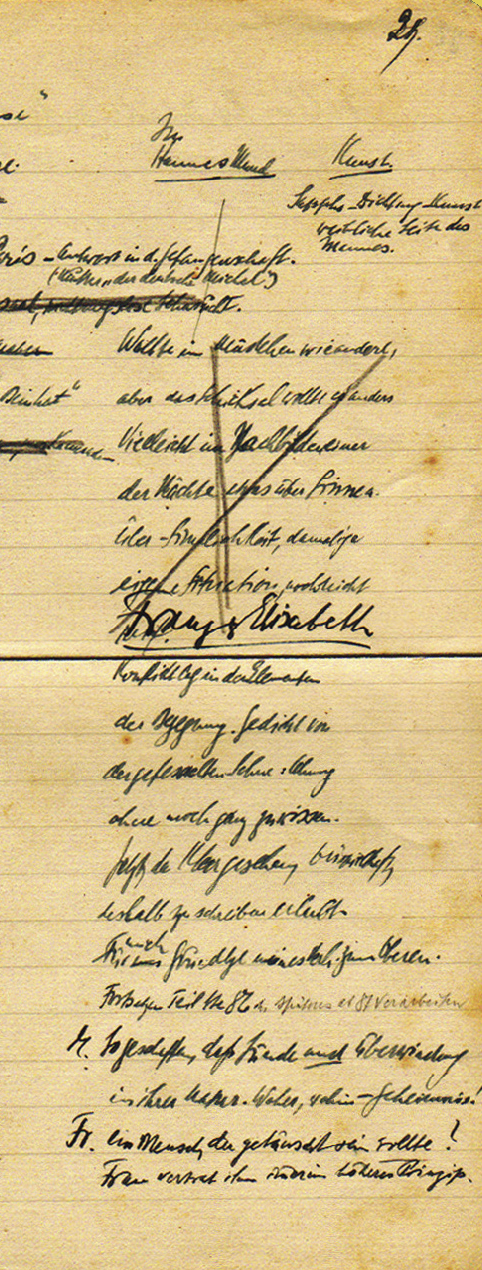
An original page from Leopold’s diary, written about Elisabeth during his years in captivity.
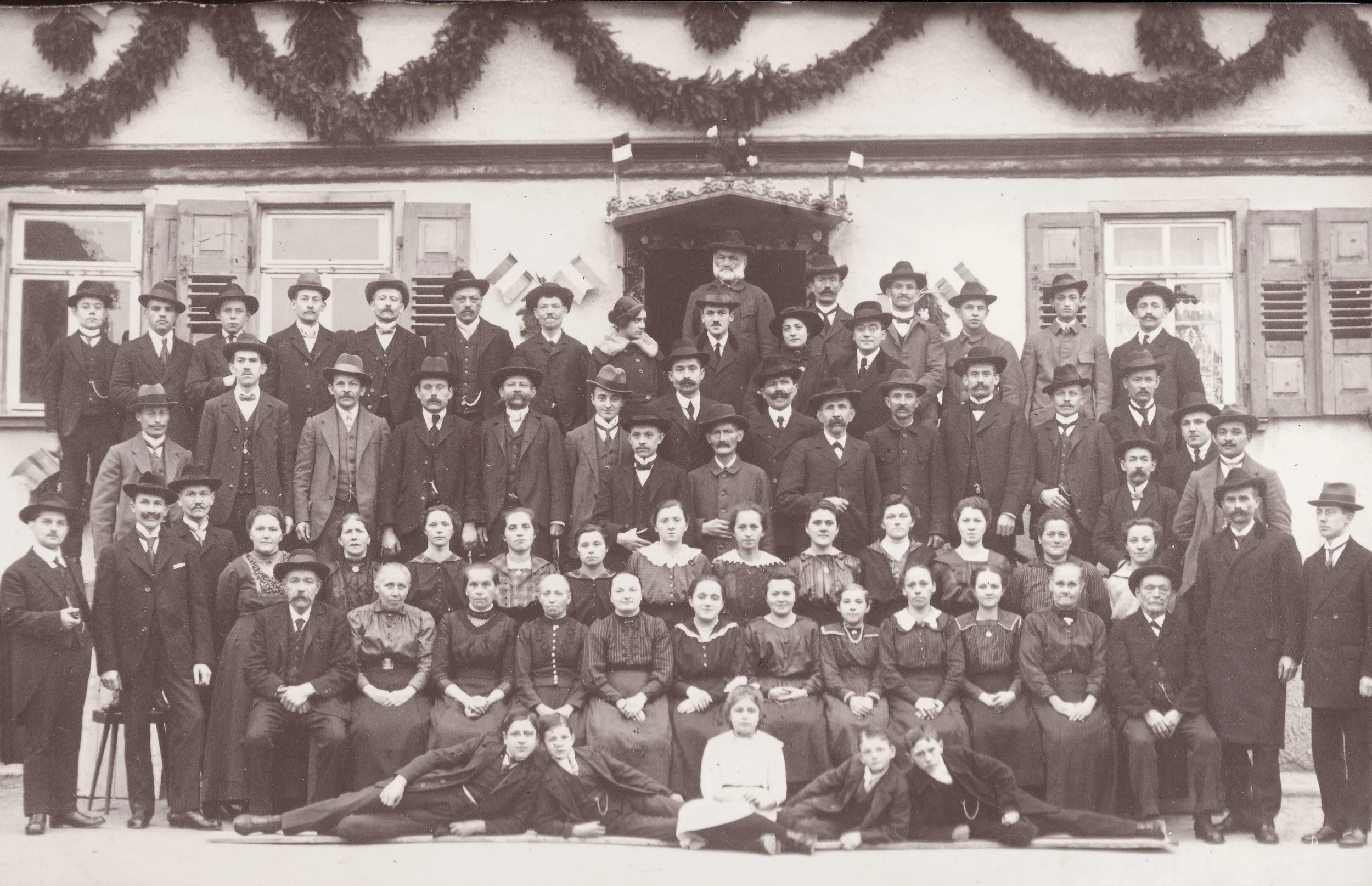
Late 1919 reunited with the factory workers- Greta Marx is the young woman in the middle of the top row, looking to the right. Next to her is her older brother, Julius, and to his right are Judith and Leopold.
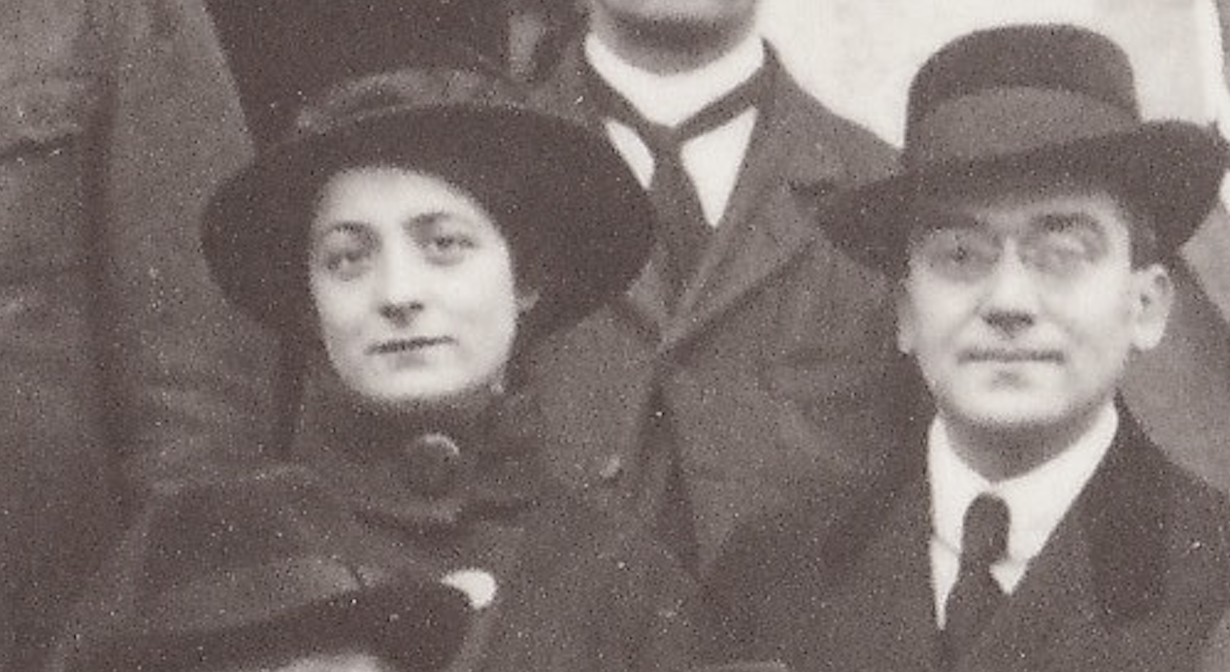
Judith and Leopold
Less than a year after Leopold returned home, his wife Judith became pregnant with their first son, Yehoshua.
Leopold later wrote that those days were filled with “strange events that cannot be described in words, and dreams that touched the mysterious world where death and life meet.”
One night during the pregnancy, Judith dreamed of Elisabeth.
She described the dream to Leopold as a blessing from someone “dear and familiar” - a blessing that, she believed, would accompany the life of the child who had not yet been born. In the dream, only Elisabeth’s eyes appeared - “large, radiant eyes that had already overcome death” - opening wide with love. Then a voice was heard:
“Your child has a soul.”
Leopold and Judith came to believe that the soul entering their unborn child, Yehoshua, was Elisabeth’s - that in some way, she was returning to them through him.
Only years later would the dream take on another, more haunting meaning - as if, together with the blessing, Elisabeth had also carried some early knowledge of the child’s fate.
Leopold later wrote to his son: “It was the voice - and the soul - of a woman whose life was short but full. She left this world at the age of 27 -just like you.”
This chapter is dedicated to his memory.
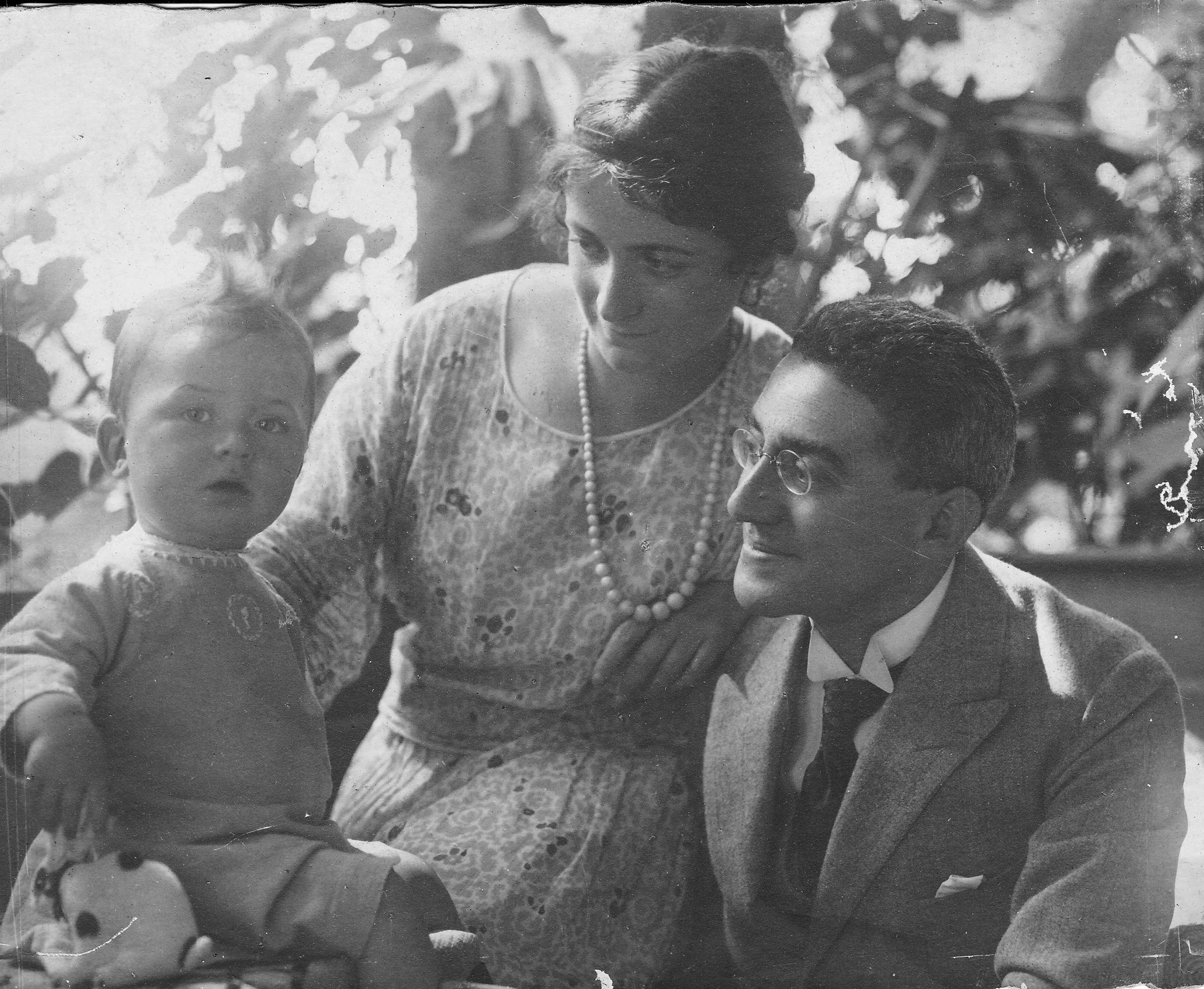
Judith, Leopold and Erich Yehoshua - 1921